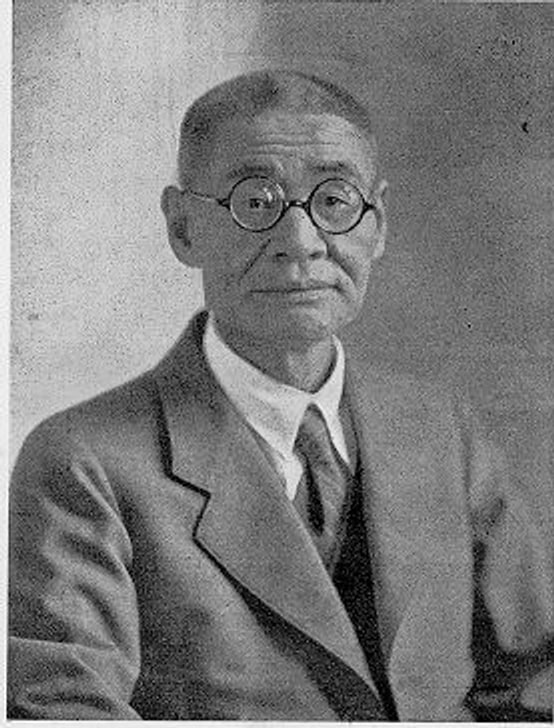
In the Yamada Yoshio feature, we read a highly abstract grammatical theory that asked “why does a sentence feel complete?” Hashimoto Shinkichi (1882–1945; born in Tsuruga, Fukui Prefecture; professor at Tokyo Imperial University), whom we read in this feature, was in sharp contrast. He did decisive work in two different areas of Japanese by relying only on what can be checked by ear, and what can be checked by eye.
Two discoveries
In the study of Japanese, Hashimoto’s name turns up in two entirely separate places.
- Bunsetsu — the idea of cutting a sentence at the natural breaks in pronunciation, as in “hana ga | saita.” Hashimoto’s grammar became the foundation of the Japanese grammar taught in schools.
- Old Japanese kana usage (jōdai tokushu kanazukai) — the discovery that in Nara-period texts, kana that sound identical in modern pronunciation — such as ki, ke, and ko — were written strictly with two separate groups of man’yōgana characters. It became a key for excavating the older sounds of Japanese from the way its characters were used.
A map of this feature
This feature first introduces the two discoveries with as little jargon as possible: what is a bunsetsu? (Plain-language explainer 1) and what is Old Japanese kana usage? (Plain-language explainer 2). Then we go back to the primary sources and read Hashimoto’s own words: the distinction between “independent words” and “attached words” that underlies the bunsetsu, in Shin Bunten Bekki (Close reading 1); and the discovery of the two-way man’yōgana sorting, in Kodai Kokugo no On’in ni Tsuite (Close reading 2). After that, how the two discoveries connected to later Japanese linguistics (Legacy and influence), and an assessment from today’s vantage point (Verdict) close the feature.
What to watch for
One thing up front. Neither discovery in this feature is a story of “a lone genius who suddenly had a flash of insight.” Bunsetsu theory took shape as a grammar for schools, polished over time, partly in response to Yamada Yoshio’s theory. And Old Japanese kana usage, as Hashimoto himself says repeatedly in the booklet, is something first noticed by the Edo-period scholar Ishizuka Tatsumaro, then checked, systematized, and spread by Hashimoto. The essence of Hashimoto’s work was re-grounding a predecessor’s observations in firm evidence.
Summary
| Point | Detail |
|---|---|
| Who | Hashimoto Shinkichi (1882–1945, professor at Tokyo Imperial University) |
| Major works | Shin Bunten Bekki (1935), Kodai Kokugo no On’in ni Tsuite (1942) |
| Two discoveries | Bunsetsu (how to cut modern sentences) and Old Japanese kana usage (Nara-period kana sorting) |
| Method | Rests on “checkable facts” — breaks in pronunciation, patterns in the use of characters — rather than abstract theory |
In a nutshell — by piling up “checkable facts” on both the present and the past sides of Japanese, Hashimoto Shinkichi made the shape of the language easier to see.
