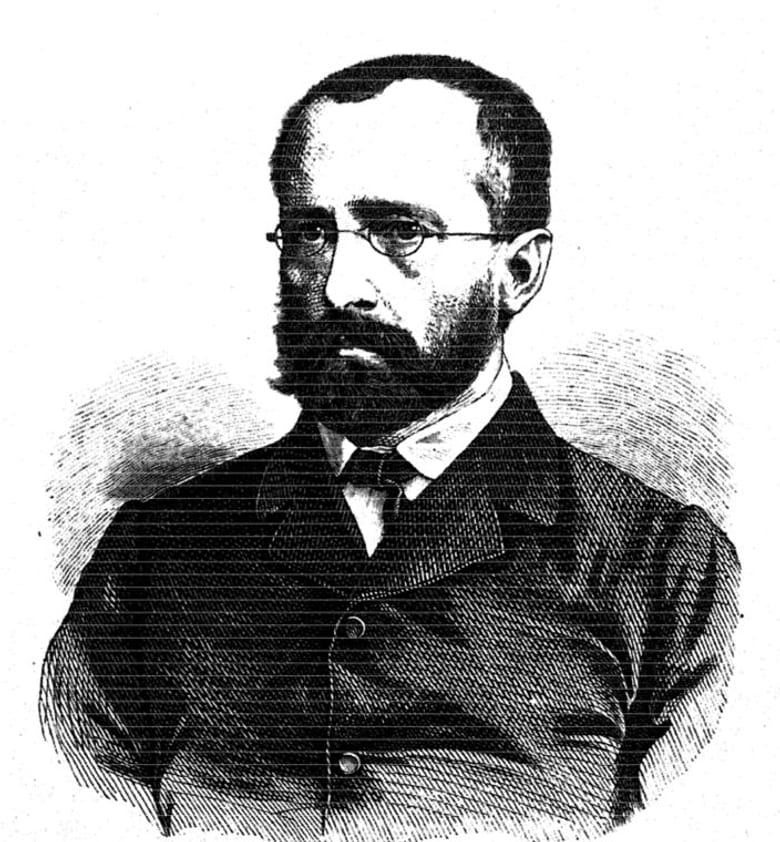
August Schleicher
Where Bopp spoke of "language as an organism" as a metaphor, Schleicher — also a lifelong botanist — took it literally. Reading the Compendium, born from fifteen years of lecture notes, from the flat claim that language has no history, through the invention of the asterisk (*) still used today, to unexpected connections to Darwin and Jespersen.
Reading August Schleicher's Compendium (1861) — A Botanist Brings Another Natural Science Into Linguistics
Where Bopp spoke of "language as an organism" as a metaphor, Schleicher took it literally. Born from fifteen years of lecture notes, this student textbook is where the metaphor turns into a scientific claim.
Language "Lives," But Has No "History" — Schleicher's Strange Assertion
Like a plant or an animal, language "lives" — and that is precisely why, Schleicher insisted, it cannot have a "history" the way humans do. Unpacking a claim that sounds contradictory at first.
Decay, Not Progress — Schleicher's View of Language History
Language first develops into a perfected form, then does nothing but decay — that was Schleicher's view. More than half a century later, Jespersen would argue the exact opposite.
Close Reading — "Language Lives But Has No History," and a Three-Stage Classification
A single sentence, tucked into a footnote in the introduction to the Compendium. And Schleicher's own notation system, lining up Chinese, the Finnic languages, and the Semitic family into three stages. Read in the original German.
Close Reading — Inventing the Asterisk (*), or How to Write Down a Reconstructed Ancestor
The symbol every comparative linguist still reaches for today — the asterisk (*) — was first used systematically by Schleicher himself. Reading the origin of this notation in a two-line footnote.
Legacy — Inherited from Bopp, Linked to Darwin, Overturned by Jespersen
Schleicher inherited the metaphor "language is an organism" from Bopp and took it literally. In 1863 he wrote an open letter connecting Darwin's theory of evolution to linguistics in his own hand. Half a century later, Jespersen overturns his view of history outright.
Verdict — How Schleicher's Compendium Looks From Nearly Two Centuries Later
The asterisk (*) notation is still alive today. The three-stage classification is still referenced. But the flat claim that "language lives but has no history," and the view that development is followed only by decay, were both overturned in the twentieth century. The closing chapter of a seven-feature history series.