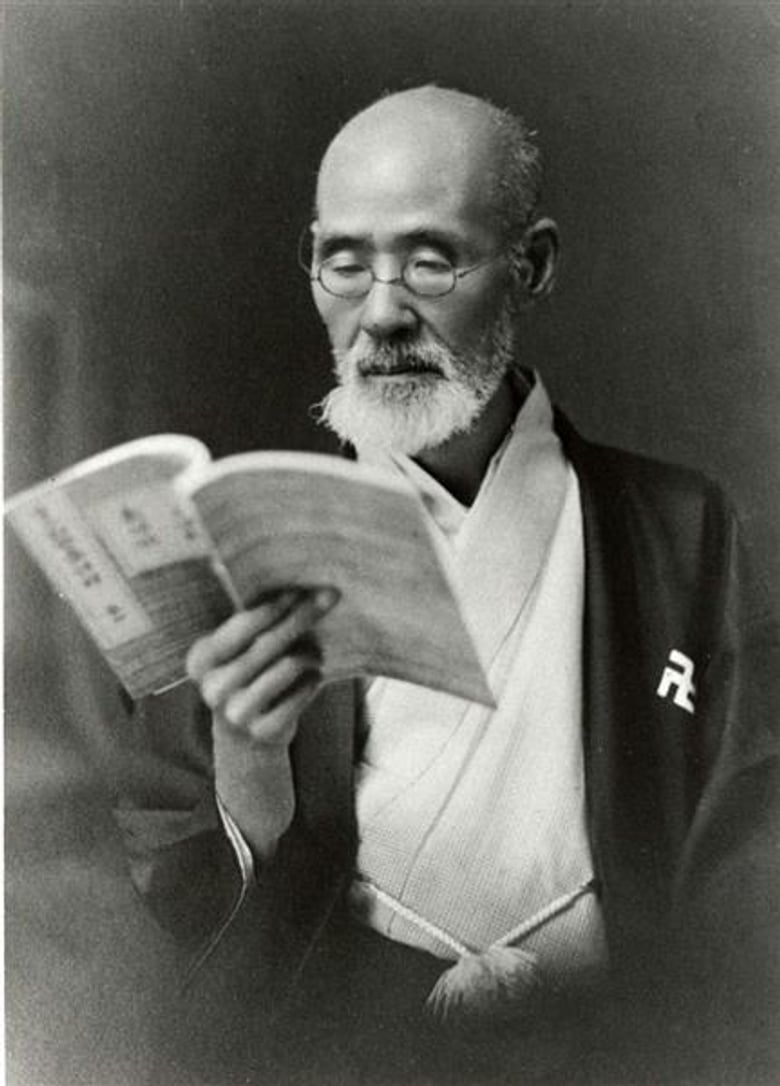
Ōtsuki Fumihiko
A scholar of Japanese classical studies, ordered by the Ministry of Education to simply "make a dictionary of the national language." With no model to follow, he designed the very skeleton of a modern Japanese dictionary — gojūon order, pronunciation notation, parts of speech, definitions in Japanese. Reading Genkai (1889–1891), the first feature in the Modern Classics of Japanese series.
Reading Ōtsuki Fumihiko's Genkai (1889–1891) — When Japan Had No Modern National Dictionary
A young scholar of Japanese classical studies is summoned by the Ministry of Education and given one order: make a dictionary of the national language. There is no model to follow, almost no precedent to draw on. Fourteen years later, Japan's first modern national dictionary is born.
The Idea of Ordering Words "A, I, U, E, O"
When we look something up in a dictionary today, we take it for granted that we start from the "a" row. But that "given" was never there from the start. Wordbooks before the Edo period were organized on an entirely different principle.
Explaining Japanese in Japanese — An Invention So Obvious It Goes Unnoticed
How would you explain the word "dog"? Not by pointing to the character for it, but by paraphrasing its meaning in other words — Genkai was the first Japanese dictionary to carry out this seemingly obvious task in earnest, across its whole length.
Close Reading — "This Book Is a Dictionary of Ordinary Japanese Words": Ōtsuki States His Own Principles
What to include, and what to leave out. How to distinguish pronunciations, how to mark parts of speech — in Genkai's preface, "The Main Intent of This Book's Compilation," Ōtsuki explains, in his own words, a design that no one had yet worked out systematically. Read in the original.
Legacy — A Dictionary That Began as a State Project, Carried Out by "Ōtsuki Fumihiko Alone"
Nishimura Shigeki, head of the Ministry of Education's compilation bureau, closed his preface with these words: "the one entrusted with this book's compilation is Ōtsuki Fumihiko, alone." A project ordered by the state, carried entirely on one person's shoulders — and what became of that work afterward.
Legacy — Why Genkai's Skeleton Still Survives in Every Japanese Dictionary
The Kōjien, the Daijirin — every dictionary arranges words in gojūon order, marks part of speech, and defines them in Japanese. This taken-for-granted skeleton all traces back to Genkai. Why has one dictionary remained the "template" for more than 130 years?
Verdict — How Genkai Looks From More Than 130 Years Later
Gojūon order, pronunciation notation, part-of-speech classification, definitions in Japanese — the skeleton Genkai built is still alive today. But the individual definitions it contains naturally carry the limits of the Meiji era as well. Grading a project that began with no model to follow, from the vantage point of more than 130 years later.