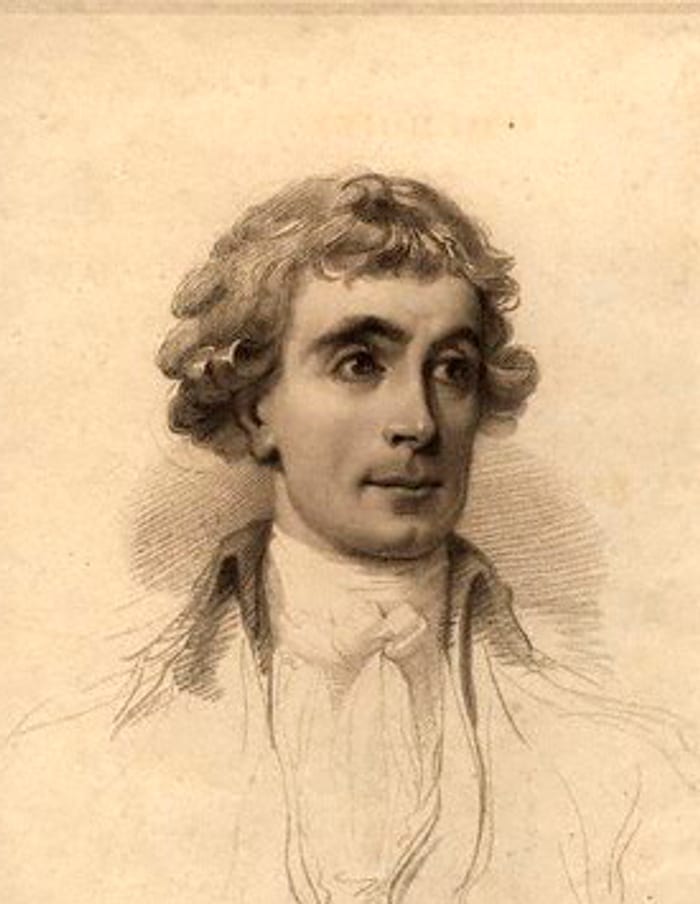
William Jones
A Calcutta supreme court judge, in his annual address to the Asiatic Society, let slip a single paragraph — pointing out a resemblance between Sanskrit and Greek and Latin "which could not possibly have been produced by accident." That one line became the starting point for comparative philology and the whole idea of an Indo-European language family. Reading the February 2, 1786 discourse.
Reading William Jones's Third Anniversary Discourse (1786) — One Paragraph That Started a Discipline
A Calcutta supreme court judge, in his annual address to the Asiatic Society, let slip a single paragraph — pointing out a resemblance between Sanskrit and Greek and Latin "which could not possibly have been produced by accident." That one observation became the starting point for comparative philology and the whole idea of an Indo-European language family. Reading the February 2, 1786 discourse from the original text.
Jones's Discovery, in Plain Words
Sanskrit resembling Greek and Latin wasn't a coincidence — and from that one insight came the idea that languages have family trees. Tracing the path with no jargon at all.
Jones's Discovery, Topic by Topic
Why a judge ended up reshaping linguistics. From the discourse's four pillars to an overreaching comparison in mythology, and on to the successors who did the follow-up work. The Third Anniversary Discourse, taken one short topic at a time.
Not Accident, Not Borrowing — Jones's Comparative Logic
Resemblance has three possible explanations — accident, borrowing, and common ancestry. How did Jones rule out the first two? Reading a second analogy, drawn from the history of conquest, and the same logic extended all the way to writing systems.
Comparing Gods — How Far the Same Method Reached, and Where It Overreached
Jones extended the same logic he used for language into mythology and philosophy. A correspondence between Greek and Hindu gods, a kinship between Plato and the Vedanta — and then, equating Odin with the Buddha, a clear overreach. Reading the light and shadow inside one address.
Reception and Legacy — From Intuition to Law
Jones's paragraph never became a discipline on its own. Forging the intuition that resemblance "could not be an accident" into an actual rule of which sound corresponds to which fell to the generation that grew up in Europe after his death. Reading the road through Bopp, Rask, and Grimm.
The Verdict — What Happened to Jones's Predictions About Language
Not just Sanskrit, Greek, and Latin, but Gothic, Celtic, Old Persian, and the Chinese-Tibetan correspondence too. Taking Jones's family-tree predictions one at a time and reading what more than two centuries of linguistics has had to say about each.