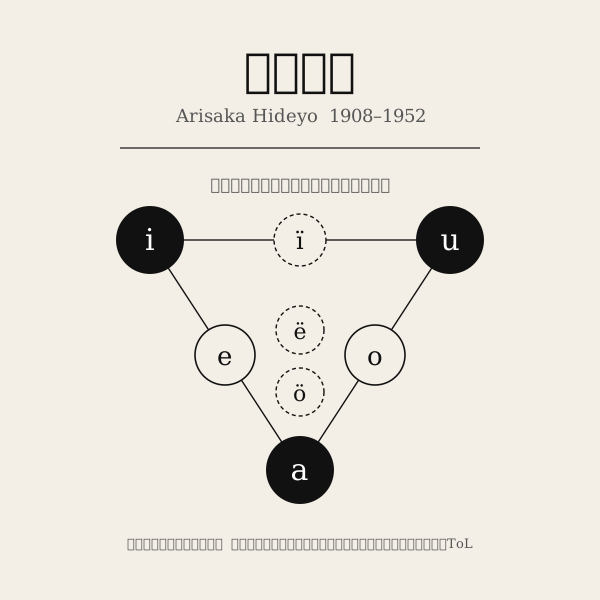
At the end of the Hashimoto Shinkichi feature, the distinction between Type A and Type B man’yōgana that Hashimoto found was handed to the next generation, along with his careful stance of “don’t pin down what the sounds were yet.” Arisaka Hideyo (1908–1952), whom we read in this feature, is the leading figure of that next generation. He died in his early forties, but left two major contributions on the old sounds of Japanese and on the question of what a “sound” is at all.
Two works
- The idea that Nara-period Japanese had eight vowels, and the law of vowel combinations within words that supported it (“Arisaka’s Law”). Arisaka backed the view that the A/B distinctions among ki, ke, ko, and so on, which Hashimoto had lined up, were differences in vowels, using regularities inside words.
- Onin-ron (1940). A book that builds up, using Japanese examples, the distinction between phonetic sounds and phonemes, and what a phonemic system is — in direct argument with the latest European theory of the day (Saussure, the Prague School).
A map of this feature
First, three articles on the sounds of Japanese themselves: how five vowels become eight (Plain-language explainer 1); the combinations of vowels that never appear together in one word (Plain-language explainer 2); and, on sounds versus phonemes, whether the sound of “n” (ん) is really one sound (Plain-language explainer 3). Then we read two passages from Onin-ron in the original: where he compares a phoneme to a “coin” (Close reading 1), and where he says a phonemic system is “an institution inherited from our ancestors” (Close reading 2). Finally, we sum up how Arisaka’s work is regarded today (Legacy and verdict).
A caveat up front
The primary source of this feature is Arisaka’s Onin-ron, which anyone can view at the National Diet Library. The papers in which he first set out the eight-vowel theory and Arisaka’s Law, however, are not publicly viewable online. So those two subjects (plain-language explainers 1 and 2) are explained as well-known facts of Japanese linguistics and contain no quotation from Arisaka’s own text. Each article says so explicitly.
Summary
| Point | Detail |
|---|---|
| Who | Arisaka Hideyo (1908–1952) |
| Two works | Research on the vowels of old Japanese (eight-vowel theory, Arisaka’s Law) and Onin-ron (1940) |
| Relation to Hashimoto Shinkichi | Supported, through regularities inside words, a path to interpreting Hashimoto’s A/B distinctions as differences in vowels |
| Primary source | Onin-ron (freely viewable at the National Diet Library) |
In a nutshell — while closing in on the identity of the “two sounds” that Hashimoto found, Arisaka Hideyo also re-asked, using Japanese examples, what it means at all to “distinguish sounds.”