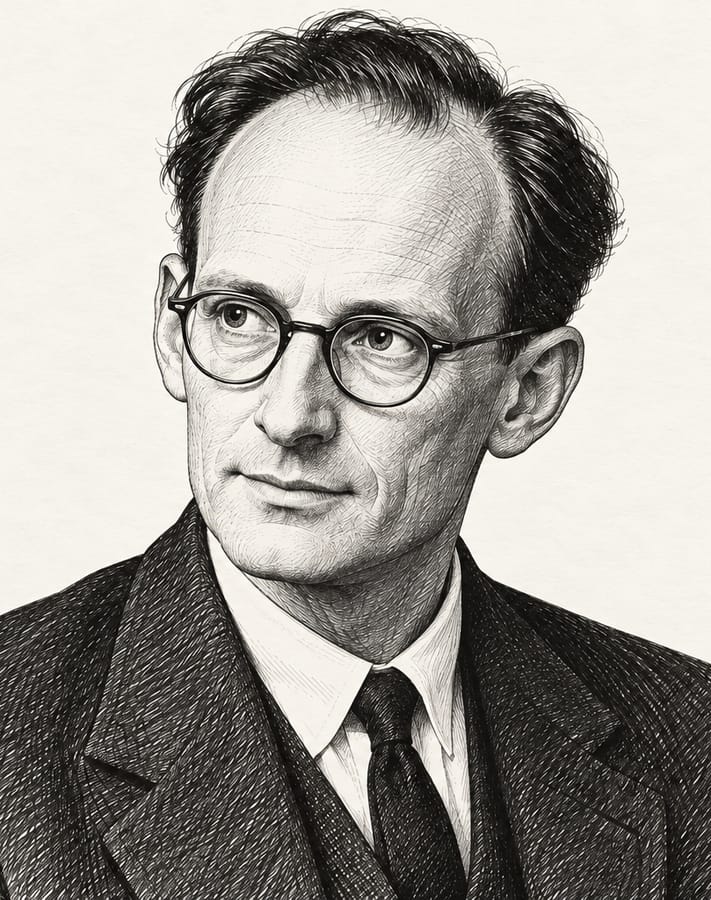
How to Do Things with Words is a book of twelve lectures published by Oxford’s Clarendon Press in 1962. Its author, J. L. Austin (John Langshaw Austin, 1911–1960), did not live to see it in print. Born in Lancaster, he went from Shrewsbury School to Balliol College, Oxford, and became a classicist Fellow of All Souls College in 1933 and of Magdalen College in 1935. He served in British military intelligence during the Second World War, then returned to Oxford, where in 1952 he was appointed White’s Professor of Moral Philosophy. The central figure of the “Oxford ordinary language” school, he published only a handful of papers in his lifetime — and died suddenly of cancer in 1960, at forty-eight.
The book is not Austin’s own manuscript. As the editor’s preface explains, it grew out of the notes Austin prepared for the 1955 William James Lectures at Harvard. In Austin’s own words, the views behind them “were formed in 1939,” first appeared in print in the 1946 paper “Other Minds,” and were reworked each year from 1952 to 1954 in a series of Oxford lectures titled “Words and Deeds.” The Harvard notes were the fullest version of that material, but much of the text was fragmentary — so the editor, J. O. Urmson (joined by M. Sbisà only for the 1975 second edition), cross-checked it against notes taken by listeners on both sides of the Atlantic, a BBC radio talk on “Performative Utterances,” and a 1959 tape recording of a lecture in Gothenburg, assembling one volume with the lightest possible editing. This is, by the editor’s own account, a book Austin “would certainly have recast” had he prepared it for print himself — repetitions, loose ends and all, it carries the texture of the lectures themselves.
1. The starting point — the assumption that every “statement” is true or false
Lecture I opens by doubting a long-standing assumption of philosophy:
It was for too long the assumption of philosophers that the business of a ‘statement’ can only be to ‘describe’ some state of affairs, or to ‘state some fact’, which it must do either truly or falsely. (Japanese and English renderings of quotations throughout are ToL’s own.)
Grammarians had long pointed out that not every sentence is a “statement” — there are also questions, commands, exclamations. On the philosophical side, meanwhile, the logical-positivist idea that only verifiable statements carry meaning had driven the discovery that many apparent “statements” are pseudo-statements of one kind or another (nonsense, the expression of feeling, the pronouncing of a norm). Austin takes up that thread but cuts in from a different angle: some sentences were never in the business of describing or reporting facts at all — and far from being a marginal exception, this turns out to be commonplace.
2. Discovering the performative — weddings, launchings, a bet
Austin’s first four examples are these:
- (E. a) ‘I do (sc. take this woman to be my lawful wedded wife)’ — spoken during a marriage ceremony
- (E. b) ‘I name this ship the Queen Elizabeth’ — spoken while smashing a bottle against the hull
- (E. c) ‘I give and bequeath my watch to my brother’ — occurring in a will
- (E. d) ‘I bet you sixpence it will rain tomorrow.’
These share a property. They do not describe or report anything, and they are neither true nor false. Uttering them, in the appropriate circumstances, simply is the performance of an act.
To name the ship is to say (in the appropriate circumstances) the words ‘I name, &c.’. When I say, before the registrar or altar, &c., ‘I do’, I am not reporting on a marriage: I am indulging in it.
Austin names this kind of sentence a “performative” — coined, he notes, from the verb “perform,” and preferred over an earlier attempt, “performatory,” which he found longer and clumsier. Against it he sets a companion term for the ordinary, truth-evaluable statement that “describes” a fact: the “constative.” He deliberately avoids the word “descriptive” itself, on the grounds that not every true statement is naturally called a description — an ethical proposition, for instance.
3. Explicit performatives and the “hereby” test
Among performatives, Austin singles out those that name the very act being performed with a first-person-singular, present-indicative, active verb — “I promise,” “I warn,” “I bet.” He calls these “explicit performatives,” identifiable by a simple test: the sentence still makes sense with “hereby” inserted (“I hereby promise…”).
Pushed further, this idea uncovers a hidden performative behind sentences that look like plain statements:
‘Out’ is equivalent to ‘I declare, pronounce, give, or call you out’ … ‘You are warned that the bull is dangerous’ is equivalent to ‘I, John Jones, warn you that the bull is dangerous’ or ‘This bull is dangerous. (Signed) John Jones.’
The umpire’s “Out!” and the sign’s warning both expand, on this account, into an explicit form with a first-person agent and a named act — Austin makes the same point about a courtroom “guilty” verdict. This is where his argument stands at this stage.
4. When it goes wrong — the felicity conditions
A performative can fail in a way quite different from being false. A wedding vow or a ship-naming only “comes off” when the right procedure, the right people, and the right circumstances are all in place. Austin calls this the axis of “happiness/unhappiness,” and gathers the ways it can fail under the heading of “infelicity.” When the procedure itself is not properly carried through, the act does not even come off — a “misfire” (no marriage has taken place at all); when the procedure is carried through but done insincerely, the act comes off hollow — an “abuse” (a “promise” made with no intention of keeping it). Six rules (A.1, A.2, B.1, B.2, Γ.1, Γ.2) are built on this distinction — the subject of a separate article in this feature.
5. The distinction starts to collapse
From Lecture IV on, Austin tries to pin the performative down grammatically, working through lists of candidate verbs. The effort meets an ironic end. Apply the same “expansion into an explicit form” test to an ordinary constative — “The cat is on the mat” expands readily into “I state that the cat is on the mat.” If so, is every statement, at bottom, a disguised performative built on the verb “state”?
Looking back on this in the résumé of Lecture XII, Austin puts it this way:
The doctrine of the performative/constative distinction stands to the doctrine of locutionary and illocutionary acts in the total speech act as the special theory to the general theory.
The performative/constative distinction is not simply discarded — but it is no longer the master framework. It is relocated as one special case inside a broader theory of “saying” itself.
6. Toward the general theory — locutionary, illocutionary, perlocutionary acts
The general theory Austin sets out in Lecture VIII separates three acts folded into a single utterance.
An utterance first says something (the locutionary act). But in saying it, the utterance simultaneously does something else — warning, requesting, promising, ordering, a conventional act performed “in” the saying (the illocutionary act). And beyond that, the utterance can also bring about an effect on the hearer — persuading, startling, angering, a consequence produced “by” the saying (the perlocutionary act). The names “illocutionary” and “perlocutionary” are built directly out of that “in” and “by.”
On this later view, the old performative/constative distinction had only ever captured the difference between the locutionary act (sense) and the illocutionary act (force) — and only for the narrow case of the explicit performative sentence.
7. Classifying illocutionary acts — five names Austin himself did not much like
In the final lecture (XII), Austin sketches a rough classification of illocutionary acts into five families — “more-or-less rebarbative names,” in his own phrase, that he was “far from equally happy about”: verdictives, exercitives, commissives, behabitives (which he calls “a shocker”), and expositives. Their definitions and examples are the subject of a separate article in this feature.
Summary
| Question | Austin’s answer |
|---|---|
| Starting point | Doubt the philosophical assumption that every statement is a truth-evaluable description |
| Discovering the performative | “I do,” “I name,” “I bet” — sentences whose utterance simply is an act |
| Performative vs. constative | The former is assessed as happy/unhappy, not true/false; the latter is true or false |
| Felicity conditions | Without the right procedure, people, circumstances, and sincerity, an act “misfires” or is “abused” |
| The distinction collapses | Any statement can expand into “I state that…” — the boundary is not absolute |
| The general theory | Locutionary act (saying), illocutionary act (doing in saying), perlocutionary act (doing by saying) |
| Classifying illocutions | A tentative five: verdictives, exercitives, commissives, behabitives, expositives |
In a nutshell — uttering words is, more often than not, already an act. Judged solely by whether it is true or false, most of what it does stays invisible.
Why it’s still read
How to Do Things with Words was assembled from lecture notes two years after Austin’s death, yet it launched an entire new field: speech act theory. His student John Searle organized and systematized the framework in Speech Acts (1969), reworking the classification of illocutionary acts (into his own five categories) and developing the notion of “constitutive rules.” Around the same time, Wittgenstein’s claim that “meaning is use” breathes a related air, if from a different direction — both men, working independently in the Oxford–Cambridge world of the mid-twentieth century, arrived at the conclusion that language does more than mirror the world.
If Aristotle, in On Interpretation, carved out only the truth-evaluable “statement” (apophantikos logos) as logic’s proper object and set a sentence like a prayer aside from the start — then what Austin did, more than two thousand years later, was drag that very sentence back to the center of the stage. The insight that “to say is already to do” is still cited well beyond philosophy of language — in legal philosophy (the view that legal language is itself performative), in feminist theory (Judith Butler’s notion of performativity), and in the design of conversational AI systems.