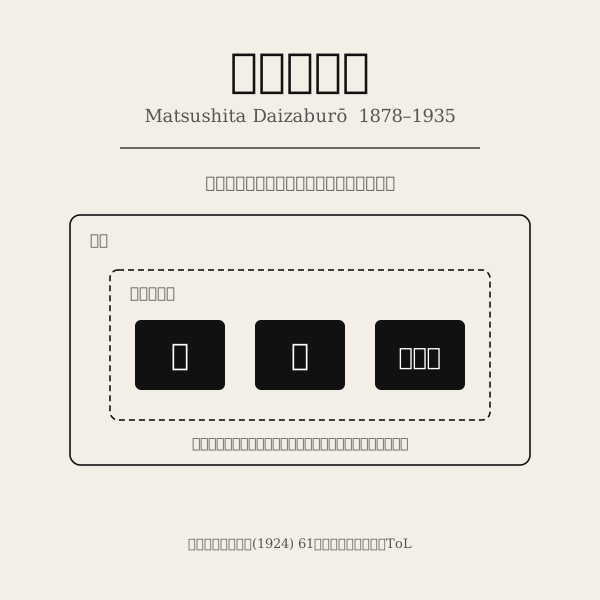
Japanese grammar as taught in school first cuts a sentence into bunsetsu, and thinks of “hana o,” “tsuki ni,” “sakimashita” as words with particles and auxiliaries attached. This way of thinking is so ordinary that it is hard to notice another way exists.
Matsushita Daizaburō (1878–1935) questioned that very starting point. The o, ni, and tari are not independent words, he held, but parts for making words. The book in which he gathered this into a system is Hyōjun Nihon Bunpō (1924). In this feature we read that book in the original and check the basics of Matsushita’s grammar one by one.
Who was Matsushita Daizaburō?
Matsushita was born in 1878 (Meiji 11) in Shizuoka Prefecture. Wanting to go deeper into grammar, he went alone to Tokyo at sixteen. He studied at Kokugakuin, and in 1899 published Nihon zokugo bunten, regarded as the first grammar of colloquial Japanese in Japan. Later he worked for many years teaching Japanese to foreign students, and in 1924 became a lecturer at Kokugakuin University. In 1932 he submitted the dissertation Kotoba no honsei-ron and became a Doctor of Letters; he died of a cerebral hemorrhage in 1935. (All of this is from Japanese Wikipedia.)
It is said that the experience of teaching Japanese to foreign students connected with his attitude of making everyday Japanese an object of grammatical study.
An outline of Hyōjun Nihon Bunpō
The book has six parts. The titles in the table of contents are as follows.
| Part | Title | A rough idea of the content |
|---|---|---|
| Part 1 | Sōron (General Introduction) | Language and grammar, sounds, script, thought, the system of language, the system of grammar |
| Part 2 | Genji-ron (Theory of Elements) | The parts of words, such as “o,” “ni,” “rashii” |
| Part 3 | Nenshi honsei-ron (The Nature of Words) | What parts of speech are, and how to divide them |
| Part 4 | Nenshi no jūteki gūsei-ron | The properties of nouns and verbs (for verbs, how the object of an action is handled, etc.) |
| Part 5 | Nenshi no ōteki gūsei-ron | Case, for nouns and verbs |
| Part 6 | Nenshi sōkan-ron | Relations between words |
The titles are hard. But the content, in fact, asks quite familiar questions.
Three things we read in this feature
First, the three units of language. Matsushita divides language into three steps: danku (the unit of utterance), nenshi (“word,” for short shi), and genji (the parts of a word). “Hana o” and “sakitari” are each one word, he says, and o and tari are their parts. (Plain-language explainer 1)
Second, the parts of speech. Matsushita organized the parts of speech of Japanese into five. From the earlier nine (noun, pronoun, verb, adjective, adverb, conjunction, particle, auxiliary verb, interjection), he removes particles and auxiliaries. The reason is told through the image of “a person and shoes.” (Plain-language explainer 2)
Third, the true nature of “kore” and “sore.” Is the kore of “Kore, nani o suru” a pronoun or an interjection? Matsushita says pronouns easily turn into interjections. The keishiki meishi (“formal nouns” — mono, koto, hazu, and the like) within the nouns are also his term. (Plain-language explainer 3, Close reading 2)
How this feature is read
Matsushita’s terms are peculiar and hard. This feature keeps to the following.
- Read in the original’s own words first. Quotations show both the original and a modern rendering.
- Write only what could be confirmed. The whole of Hyōjun Nihon Bunpō runs to over 660 pages, and much of it (the detailed classifications of the “vertical” and “horizontal” properties) is not explained in this feature.
- Put “present treatment” together at the end, as a generally known summary. (Verdict article)
Summary
| Point | Detail |
|---|---|
| Matsushita’s starting point | O, ni, tari are not words but parts of words |
| Three units | danku (unit of utterance), nenshi (word), genji (part) |
| Parts of speech | Five. Particles and auxiliaries fall outside |
| “Kore,” “sore” | Pronouns, but easily turn into interjections |
| Main work | Hyōjun Nihon Bunpō (1924). Six parts, over 660 pages |
In a nutshell — Matsushita Daizaburō stopped seeing o and ni as words, and rebuilt Japanese grammar from the relation between parts and words.