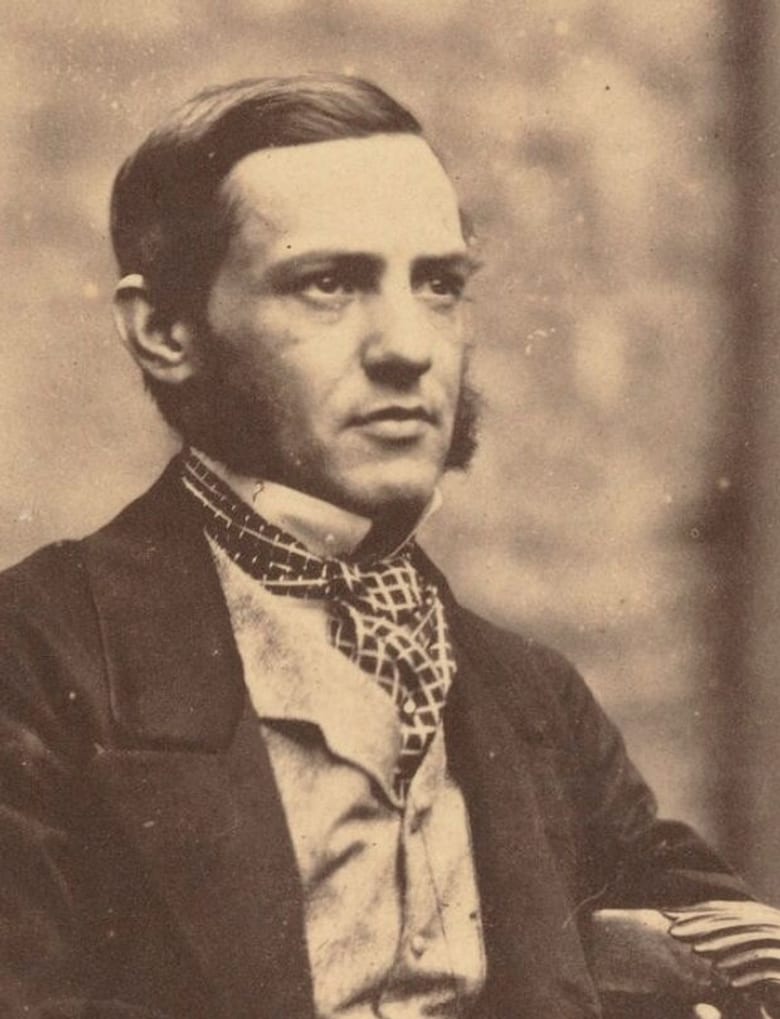
Spring 1861, at the Royal Institution in London. A weekend public lecture series was drawing packed houses. The subject was neither chemistry nor astronomy — it was “the science of language.” On the platform stood Friedrich Max Müller (1823–1900), a German-born Oxford professor. This feature covers his Lectures on the Science of Language, delivered that year and again two years later.
A poet’s son, drawn to Sanskrit
Müller was born in Dessau, Germany. His father, Wilhelm Müller, was a poet whose verses would later become immortal as the lyrics of Schubert’s song cycles Die schöne Müllerin and Winterreise — it’s tempting to say a sensitivity to the beauty of words was already bred into the family line. After earning his degree at Leipzig, Müller went to Paris to study under the Sanskritist Eugène Burnouf. In 1848, at twenty-four, he moved to Oxford and took up the project that would consume his career: editing the Rig Veda, the oldest scripture of India — a project sponsored by the East India Company that would eventually run to six volumes over more than a quarter century.
A packed lecture hall — turning scholarship public
What makes Müller’s career unusual is that, alongside this extraordinarily specialized work of philology, he was also a first-rate public lecturer. Invited by the Royal Institution in 1861, he took a subject as dry as comparative philology and made it hold its own alongside the era’s lectures on chemistry and geology. At the opening of the First Series, he frames his subject this way:
The study of words may be tedious to the school-boy, as breaking of stones is to the wayside labourer, but to the thoughtful eye of the geologist these stones are full of interest — he sees miracles on the high road, and reads chronicles in every ditch.
It was this way of reading a whole deposit of history into every single word that drew his audience in.
How fast the published lectures went through editions tells its own story. The First Series reached a fifth edition within a few years of its 1861 first printing — an extraordinary run for a scholarly book, and by any fair account the book that first made the general English-reading public aware that a field called “linguistics” existed at all.
Map of this feature
This feature traces the reach of Müller’s work, and its costs, across both lecture series. The next two articles introduce his central claims in plain language — his declaration that linguistics is a physical science, and his role as the man who fixed “Grimm’s Law” as an English name. The two after that offer a close reading of his classification of language families and his theory of comparative mythology, from the original text. And the final two take on, directly, the subject this feature has been building toward all along: how the discovery of an “Indo-European” family became entangled with the false story of an “Aryan race” — and how Müller himself came to reckon with that.
Summary
| Point | Content |
|---|---|
| Who | Friedrich Max Müller (1823–1900), German-born, based at Oxford |
| Major work | Lectures on the Science of Language, First Series (1861) and Second Series (1863) |
| His specialist work | Editing the Rig Veda (sponsored by the East India Company, six volumes) |
| Significance of this book | The bestseller that first brought “linguistics” to a general readership |
In a nutshell — Müller was the first person to turn comparative linguistics, a specialist field, into public knowledge that could fill a lecture hall. This feature reads both his achievement and its shadow.
