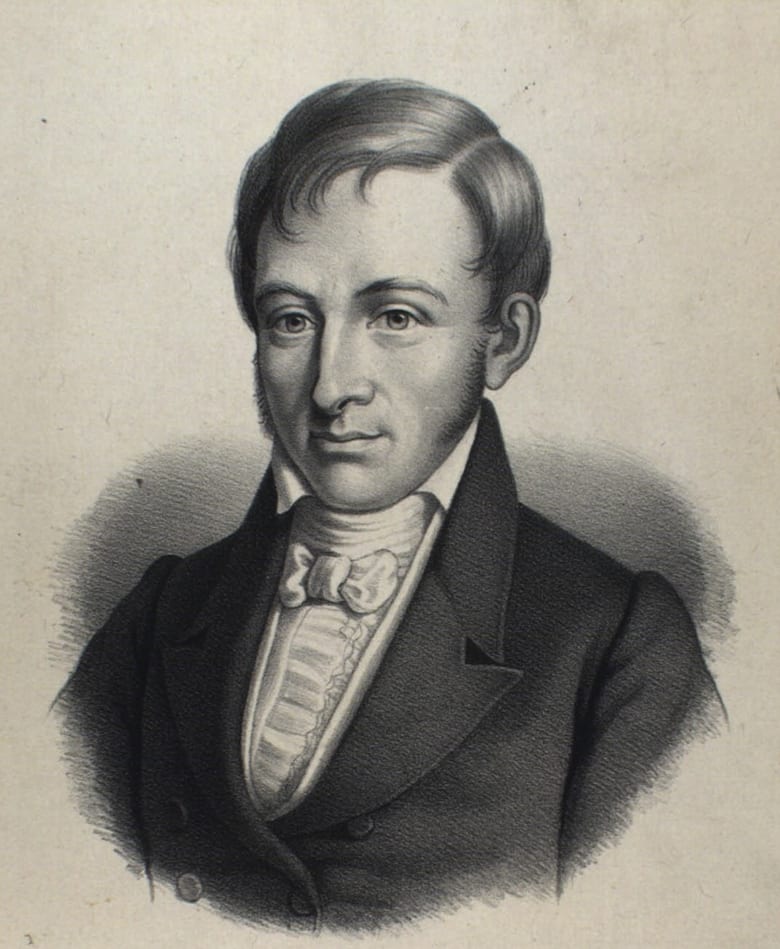
As read in this site’s Jacob Grimm feature, the direct trigger for Jacob Grimm’s 1822 second edition of Deutsche Grammatik was a prize essay. Its author was the Danish linguist Rasmus Rask (1787–1832). This feature reads that book, Investigation Concerning the Origin of the Old Norse or Icelandic Language (1818) — published four years before Grimm’s famous table.
A book written for a prize competition
In 1811, the Royal Danish Society of Sciences posed a competition question: from what source can Old Norse (Icelandic) be traced with historical-critical probability? Rask answered it in 1814, at age twenty-seven. After review, the essay was published in 1818 — its title page states plainly that it was “a prize essay crowned by the Royal Danish Society of Sciences.”
A grammarian, and a traveling linguist
Rask wrote this book as “Second Librarian” at the University of Copenhagen’s library. But his career didn’t stay confined to a desk. From 1816 to 1823 he undertook a journey extraordinary for a linguist of his era — through Sweden, Finland, Russia, Persia, India, and Ceylon (Sri Lanka) — collecting manuscripts and studying local languages at every stop. What he learned on that journey fed directly into his later work. But between overwork and the toll of that punishing travel, he died in 1832, at forty-four.
Establishing a method before Grimm did
The core of this book isn’t any single etymology, right or wrong. It’s a method: when comparing two languages, the correspondence in grammar is a far more reliable clue than the resemblance or non-resemblance of vocabulary. This claim is read in full, from the original text, in the next article in this feature. As seen in the Grimm feature, Grimm read this essay after the 1819 first edition of Deutsche Grammatik, and the observation it laid out — a regular shift in consonants — was the trigger for the second edition of 1822, more than double the length of the first.
Map of this feature
The next two articles introduce, in plain language, Rask’s central methodology and his eventful life. The two after that offer a close reading of the original Danish text — the methodology itself, and his comparative work in practice (including the contrast case of Greenlandic). This feature then covers his relationship to Grimm and his place in the history of comparative linguistics, before closing with an assessment from two centuries’ distance.
Summary
| Point | Content |
|---|---|
| Who | Rasmus Kristian Rask (1787–1832), Denmark |
| Major work | Investigation Concerning the Origin of the Old Norse or Icelandic Language (1818) |
| How it came about | A prize essay for the Royal Danish Society of Sciences (question posed 1811, submitted 1814) |
| Significance | Established the method of comparative linguistics four years before Grimm |
In a nutshell — behind the name “Grimm’s Law” stands a traveling librarian who established its method before Grimm did.
