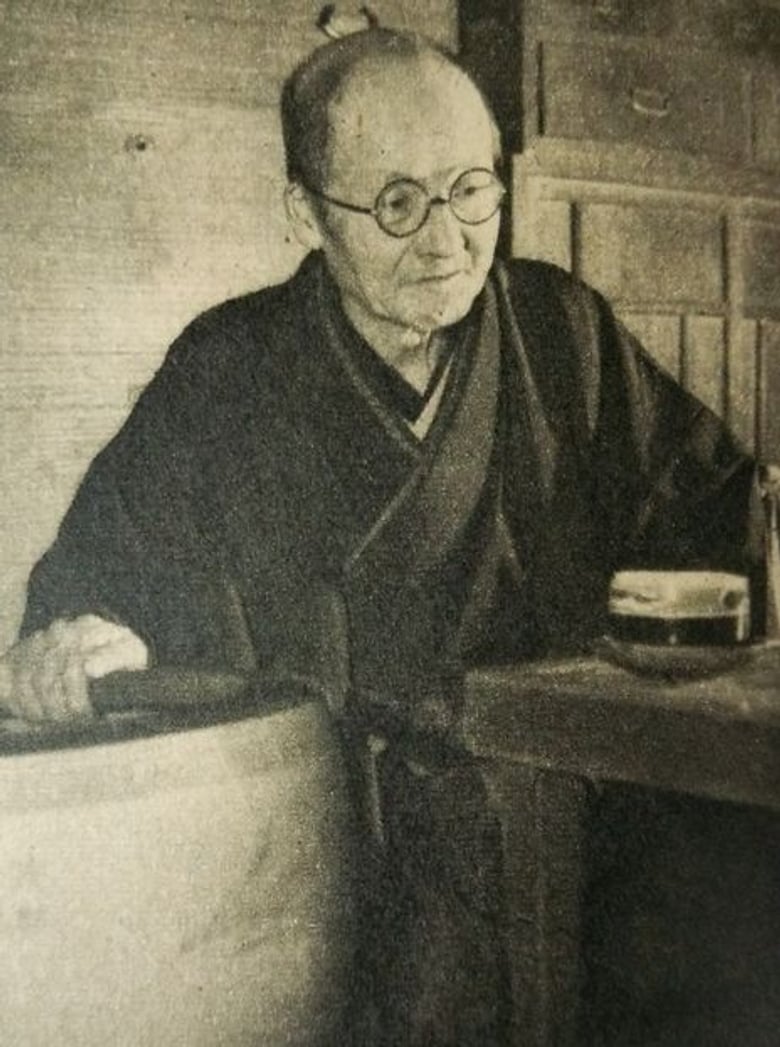
The Ōtsuki Fumihiko feature read a project dealing with a dictionary — a “collection of words.” Yamada Yoshio (1873–1958), read in this feature, took on a different challenge: how words combine into sentences — the very mechanics of Japanese grammar.
From a bookstore clerk in Toyama to a giant of grammatical theory
Yamada Yoshio, from Toyama Prefecture, had almost no formal higher education and was largely self-taught in Japanese classical studies and grammar — an unusual path for his time. Nihon Bunpōron (日本文法論, “A Theory of Japanese Grammar”), read in this feature, is the massive work he published in 1908, at age 35: an introduction plus a two-part main text, Part I “Word Theory” (語論) and Part II “Sentence Theory” (句論), running to nearly two thousand pages in total.
Cut everyone down first, then make your own case
The book’s most striking feature is its structure. Before stating his own theory, Yamada, at the start of nearly every chapter, examines and critiques, by name, one after another, nearly every major grammarian from the Edo period through the Meiji era. Fujitani Nariakira, Motoori Norinaga, Suzuki Akira, Tōjō Gimon, Ōtsuki Fumihiko — the review of prior scholarship alone would fill a substantial history of the field on its own.
On top of this thorough, critical survey, Yamada builds his own original theory. At its core are the two theories read in this feature: chinjutsu theory (why does a sentence “complete” itself?), and kakari-musubi (the agreement mechanism, unique to classical Japanese, that determines a sentence’s final form).
The map of this feature
This feature begins by introducing, without jargon, the two theories at the core of “Yamada grammar”: chinjutsu theory (the idea that the same string of words can become an entirely different kind of utterance depending only on its final form), and kakari-musubi (the classical-Japanese-specific mechanism by which a particle like “zo” or “koso” reaches across a sentence to determine the inflected form at its very end). It then closely reads the original text of Nihon Bunpōron, in Yamada’s own words. From there, it covers how Yamada grammar developed afterward, and closes with an assessment from modern Japanese linguistics.
Summary
| Point | Detail |
|---|---|
| Who | Yamada Yoshio (1873–1958, from Toyama Prefecture, a self-taught scholar of Japanese classical studies) |
| Landmark work | Nihon Bunpōron (1908) |
| Method | Critiques, by name, nearly every prior grammarian before stating his own theory |
| Core theories | Chinjutsu theory (sentence completeness) and kakari-musubi (agreement mechanism) |
In a nutshell — Yamada Yoshio cut down every predecessor’s theory, one by one, before setting down his own answer to a fundamental question: why does a Japanese sentence become a single, completed whole?
