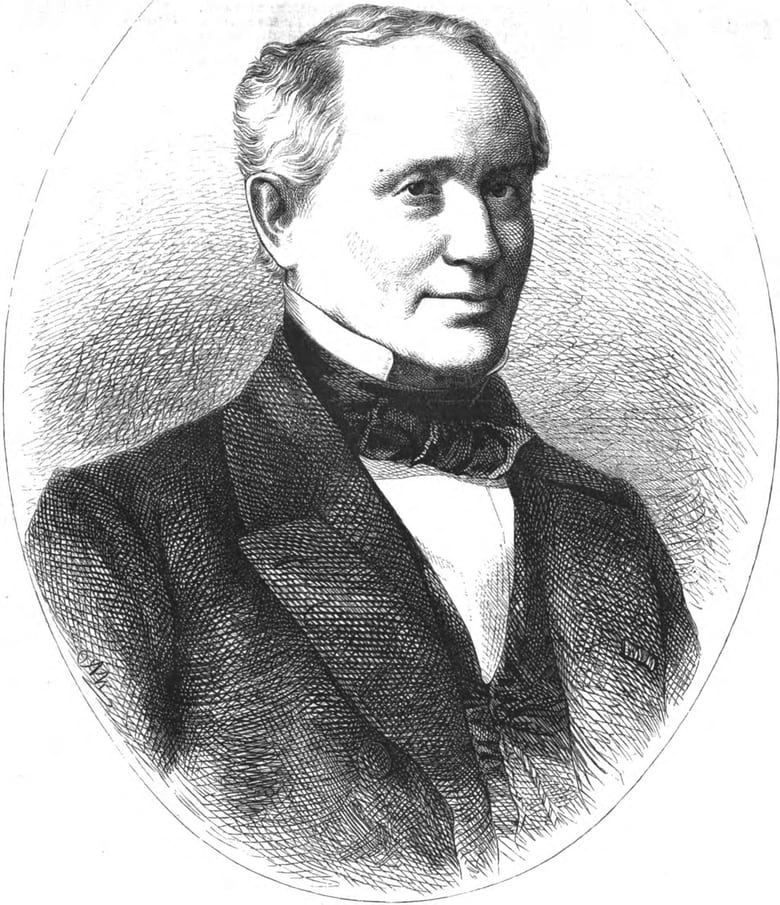
One figure has already appeared by name alone in this site’s Jacob Grimm feature: Franz Bopp (1791–1867). In 1816, at twenty-five, he published On the Conjugation System of the Sanskrit Language — a work that showed, even before Rask or Grimm, what a comparative grammar built around Sanskrit could look like. The Comparative Grammar (Vergleichende Grammatik) read in this feature is that same project, expanded and completed over a lifetime.
Sanskrit as a “new continent”
Bopp was born in Mainz and studied Sanskrit in Paris under Silvestre de Sacy and Chézy. From 1821 he held the chair of Oriental literature and general linguistics at the University of Berlin. In the preface to the Comparative Grammar read in this feature, he looks back on where his work began:
In der Behandlung unserer europäischen Sprachen mußte in der That eine neue Epoche eintreten durch die Entdeckung eines neuen sprachlichen Welttheils, nämlich des Sanskrit… (In the treatment of our European languages, a new epoch truly had to arrive, through the discovery of a new linguistic continent — namely, Sanskrit…)
Comparing Sanskrit to a “new continent” — an image drawn straight from the Age of Discovery — tells us how great a shock this ancient Indian language delivered to early nineteenth-century European scholars. A third classical language, arriving from the far East, took its place beside the established authority of Greek and Latin — and in the precision of its grammatical system, sometimes surpassed them both.
A different target from Rask and Grimm’s
As read in the Rask feature and the Grimm feature, the center of those two men’s work was the correspondence between consonants — p becoming f, t becoming th, a regularity of sound. Bopp’s target was broader. Verb conjugation, noun declension, the machinery of grammar itself, compared exhaustively, down to the last detail, across eight languages — Sanskrit, Zend (Avestan), Greek, Latin, Lithuanian, Old Slavic, Gothic, and German. That was the project of Comparative Grammar. A first edition appeared in 1833; a fully revised second edition began appearing in installments from 1856. This feature reads Volume I of that second edition.
Map of this feature
The next two articles introduce, in plain language, Bopp’s central ideas: the notion of treating language as “an organism,” and his theory that grammatical endings are “fossilized words.” The two after that offer a close reading of the original German — the preface, and the single etymological analysis that best captures his theory. This feature then traces his legacy, including his direct connection to Grimm, before closing with an assessment from nearly two centuries’ distance.
Summary
| Point | Content |
|---|---|
| Who | Franz Bopp (1791–1867), Germany, professor at the University of Berlin |
| Major work | Comparative Grammar (Vergleichende Grammatik, 1st ed. 1833, 2nd ed. 1856–61) |
| The work that came before it | On the Conjugation System of the Sanskrit Language (1816) |
| Languages covered | Sanskrit, Zend, Greek, Latin, Lithuanian, Old Slavic, Gothic, German |
| Significance | Established a method for comparing whole grammatical systems, not just sound correspondences |
In a nutshell — the regularity Rask and Grimm found in consonants, Bopp extended across the entire structure of grammar. This feature reads the inside of that structure.
.jpg)