This feature closes ToL’s history series — eight features that began with William Jones and continued through Rask, Grimm, Bopp, Müller, Jespersen, Schleicher, and Brugmann.
A question two hundred years couldn’t answer
In 1786, Jones showed that Sanskrit, Greek, and Latin must have descended from the same ancestor. From then on, linguists across the nineteenth and twentieth centuries kept refining the comparative method, reconstructing the vocabulary and grammar of this “mother tongue” — Proto-Indo-European (PIE) — with astonishing precision.
But one question remained that linguistics alone could never answer. Where, and when, was that mother tongue actually spoken? The only clues lie inside the spoken words themselves; no written record of it exists. Across the nineteenth and twentieth centuries, the debate over the “homeland” of this mother tongue drifted on without an answer — at times fueling dangerous political uses, including the Aryan myth and its exploitation by Nazi-sponsored archaeology.
An archaeologist answers from outside linguistics
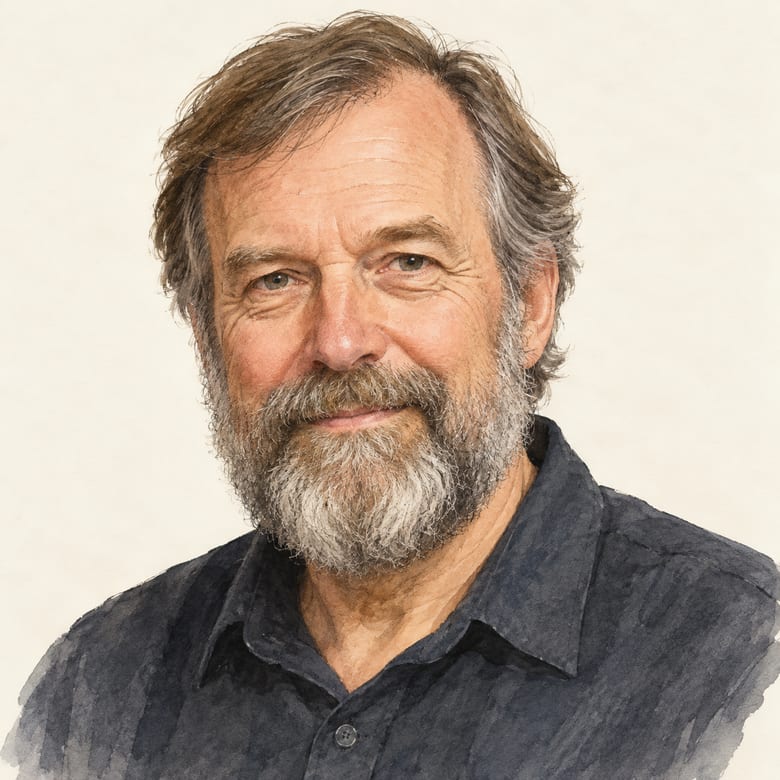
David W. Anthony (born 1949, Professor Emeritus at Hartwick College) is not a linguist but an archaeologist. He has spent decades excavating in the Pontic-Caspian steppe — the vast grassland stretching north of the Black and Caspian Seas across Ukraine, Russia, and Kazakhstan. This book, The Horse, the Wheel, and Language (2007), is the culmination of that fieldwork.
Anthony’s approach is straightforward. He treats the reconstructed vocabulary of Proto-Indo-European itself as dating evidence. Proto-Indo-European certainly had words for “wheel” and “axle.” But the wheel itself, as a technology, was not invented — archaeologically speaking — before roughly 4000–3500 BCE. That means Proto-Indo-European must have been spoken after the wheel was invented — vocabulary becomes evidence that sets a lower bound on the date.
The map of this feature
This feature begins with two articles introducing, without jargon, the most concrete and compelling parts of Anthony’s method: the investigation of bit wear on ancient horse teeth to trace the origins of riding, and the way words for wheels and wool became tools for dating a dead language. The next two closely read the original English, covering Anthony’s own methodological stance and the drama of Indo-European dispersal across the steppe. From there, it covers the connections to the figures already covered in this feature set, the controversy the book entered into, and closes with an assessment from the vantage point of nearly two decades since publication.
Summary
| Point | Detail |
|---|---|
| Who | David W. Anthony (b. 1949, USA, Professor Emeritus at Hartwick College) |
| Field | Archaeology (Pontic-Caspian steppe, horse domestication, Indo-European origins) |
| Landmark work | The Horse, the Wheel, and Language (2007) |
| The book’s place | An attempt to pin down the Proto-Indo-European homeland by combining linguistic reconstruction with archaeological evidence |
In a nutshell — the question Jones opened in 1786 finally got an answer, 221 years later, from an archaeologist reading horse teeth and the word for a wagon. This is where the history series’ final feature begins.